The Physics of Illumination: The Fresnel Lens
Before the 1820s, coastal beacons struggled against distance and weather. The invention of the stepped optical lens transformed the maritime world by bending scattered light into a single, piercing beam.
The Problem of Scattered Light
Early lighthouse illumination relied on coal fires or simple oil lamps backed by parabolic metallic reflectors (the catoptric system). While a reflector directed some light forward, a vast percentage was lost—absorbed by the metal, scattered vertically into the sky, or dispersed harmlessly into the sea.
To make navigation safer, engineers needed a way to capture all the light emitted from a source and compress it into a tight, horizontal plane. Solid glass lenses could do this, but a solid lens large enough for a lighthouse would be incredibly heavy, thick, and would absorb too much of the light it was meant to transmit.
Augustin-Jean Fresnel's Solution
In 1822, French physicist Augustin-Jean Fresnel conceptualised a breakthrough. He realised that the refractive power of a lens resides primarily at its curved surface. The internal mass of the glass simply adds weight and absorbs light.
Fresnel's design "stepped" the curved surface of a traditional lens down into concentric rings (annular prisms). This created a lens that maintained the required curvature to refract (bend) the light, but in a fraction of the thickness and weight of a solid convex lens.
Explore Beacon Technology →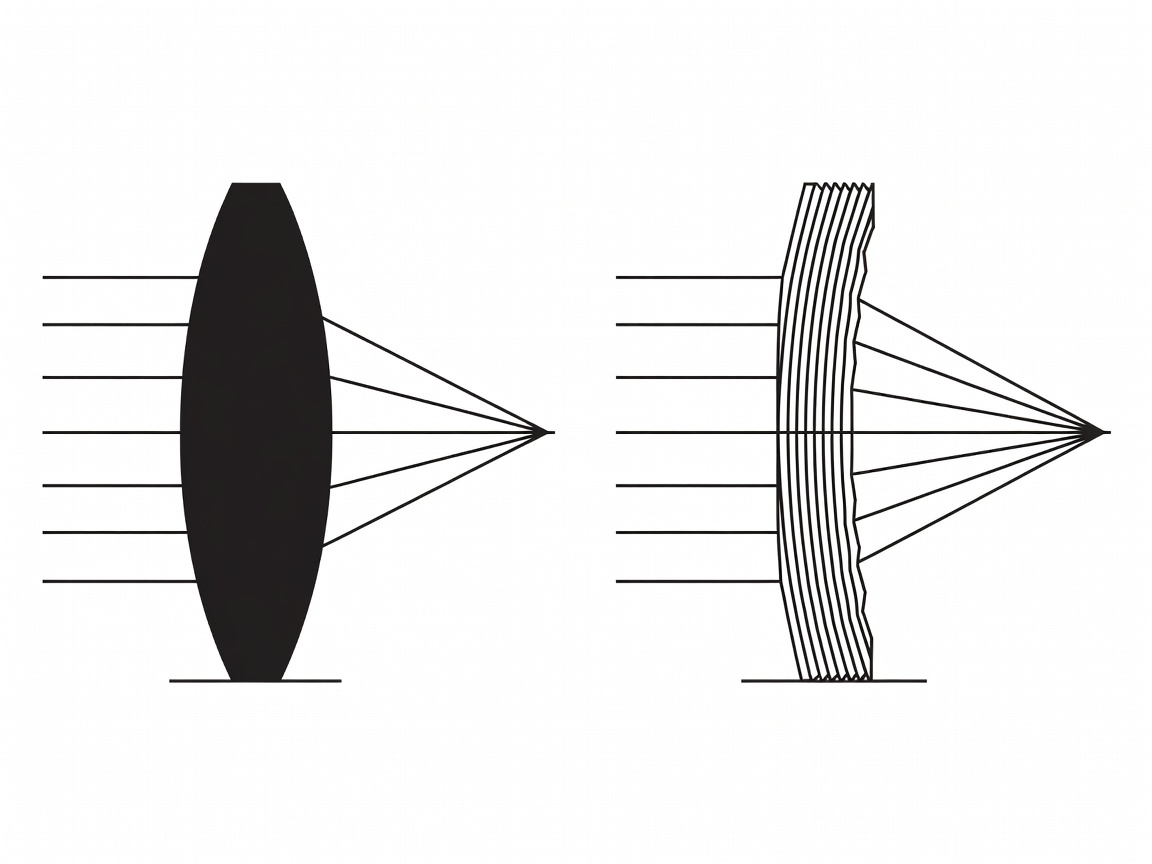
Lens Orders and Classification
As the technology became the international standard for maritime signalling, Fresnel lenses were categorised by "Orders" based on their focal length (the distance from the light source to the lens) and physical size.
First Order
The largest lenses, designed for crucial coastal landfalls. They could stand over 2.5 metres tall, weighing several tons. Used on major oceanic navigation routes where maximum range was essential.
Third Order
Mid-sized optics often found in secondary coastal lights, marking headlands or approaches to large bays and estuaries.
Sixth Order
Small lenses used in harbour entrances, breakwaters, and channel markers where visibility over massive distances was not required.